
If you know any inquisitive children (or if you’re wanting some quick facts), check out a nonfiction book about nature for children. These books will grab their interest quickly, while also filling in some knowledge gaps. Filled with gorgeous visuals, nature nonfiction for children will motivate them to spend more time outside! As of this writing, all of these titles are owned by the Davenport Public Library. Descriptions are provided by the publishers.
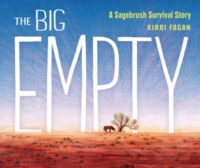
The big empty : a sagebrush survival story written and illustrated by Kirbi Fagan
People passing by call this land the big empty. / But I call it home.
In spare, poetic text written from the point of view of big sagebrush, readers are transported to the vast landscape of western North America. This incredibly resilient plant, which can live as long as one hundred years, provides food and shelter as well as shadows to conceal both predators and prey. After a wildfire passes through, it grows again and will thrive once more. Author and illustrator Kirbi Fagan captures the beauty of this essential plant in her lyrical words and richly detailed illustrations. – Millbrook Press
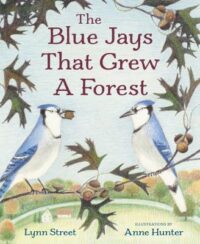
The blue jays that grew a forest by Lynn Street ; illustrations by Anne Hunter.
Take a lyrical journey on the wings of blue jays as they bury thousands of acorns for next season’s food and help Mother Nature extend the oak forests.
Most of us know about the mighty oak tree, and how important oaks are as a keystone species. But we may be less aware of the role that blue jays play in assisting the expansion of oak tree forests.
Covering one full year from season to season, we learn about the habits of the blue jays. All summer long they feed on bugs, berries, and seeds. But as autumn approaches, they perch in the canopy waiting for the acorns to ripen. With cold weather coming soon, this blue crew hauls away acorns, each bird taking as many as five per load. They fly over a farm or two and hide the acorns in a sunny open area where they can find them later when other food is scarce. But not all acorns will be eaten. Little do the jays know that the treasures they bury may one day become the beginnings of a new oak forest.
This debut picture book from poet Lynn Street lyrically celebrates the connection between blue jays and oak trees. It will appeal to readers fascinated by the behavior of birds and by the reciprocal relationships found in nature. While jays depend on acorns for food, the oak depends on jays to scatter its fruit far and wide. Blue jays have specially developed pouches in their throats that allow them to carry several acorns at a time, and they can travel as far as 1,500 miles in a season burying their acorns. A keystone species in oak forest ecosystems, these familiar birds are thought to have contributed to reestablishing oak forests after the last ice age. The detailed back matter provides further information about oaks and jays.
Geisel Honoree artist Anne Hunter, who lives in the jay-filled woods of Vermont, illustrated this book with great affection for these beautiful, clever, and sometimes noisy birds. After reading this book, you will see blue jays in an entirely new light. – Peachtree Publishing
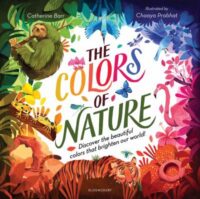
The colors of nature : discover the beautiful colors that brighten our world by Catherine Barr ; illustrated by Chaaya Prabhat
Boldly illustrated and filled with fun nature facts, this nonfiction picture book invites readers to explore the dazzling colors of our world.
Uncover the wonders of nature with this spectacular exploration of the colors of our world by expert conservation author Catherine Barr and incredible illustrator Chaaya Prabhat.
Did you know that some lizards have poisonous lime green blood and bones? Or that octopuses flush red when angry? Or that tigers actually look green to deer?
With a different color from the rainbow revealed on every page, this gorgeous book is a feast for the eyes! Whether they love brilliant blue, fiery orange, or earthy brown, young readers will delight in this vivid celebration of color. – Bloomsbury Children’s Books
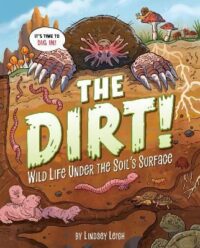
The dirt! : wild life under the soil’s surface written and illustrated by Lindsey Leigh
Dig into the often messy world of critters who live underground and learn about why soil is essential to life on earth!
Did you know there is an entire ecosystem right beneath our feet? Have you ever heard of the “poop loop”? This graphic nonfiction title will both educate and excite young readers about the wonders (and creepiness!) of animals that live underground, including worms, beetles, armadillos, badgers, and even the tiniest of protozoa.
Author and illustrator Lindsey Leigh continues her popular and humorous trilogy by introducing critters of all sizes in this fact-filled book about the dirt-dwelling creatures that contribute to the soil food web and are crucial to the health of the world. Join her on this graphic and grimy deep dive into The Dirt! – Penguin Workshop
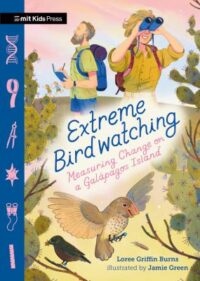
Extreme birdwatching : measuring change on a Galápagos Island by Loree Griffin Burns ; illustrated by Jamie Green
A treasure trove for science classrooms, citizen scientists, and budding biologists, this “you-are-there” account of a landmark study of wild finches going about their finch-y business captures the scientific process in action.
Daphne is an island. Not one you’d choose for a vacation. There are no sandy beaches, resorts, hotels, or houses. No tall trees to make shade. The steep, rocky sides of a volcanic Galápagos island are not inviting, and most who visit this part of the world sail right past. But Peter and Rosemary Grant are not most people. A husband-and-wife team, the Grants came to this singular place with a singular goal: to study two species of wild finch. For decades, the scientists and their students counted, cataloged, and observed finches on a remote mile-wide island. Through teamwork, painstaking observation—extreme bird-watching, extreme plant study, extreme seed counting—and careful beak measurements, the group of committed scientists proved step-by-step, over forty years, how finch beaks change in response to their environment. Weaving accessible biology and the scientific process into an inspiring conversational narrative, this second title in the Discovery Chronicles series—packed with resources and back matter—concretely honors the value of hard journeys, the vision and ambition behind tedious tasks, and the astonishing power of curiosity. – MIT Kids Press
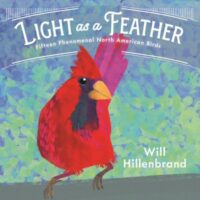
Light as a feather : fifteen phenomenal North American birds written and illustrated by Will Hillenbrand
Let your curiosity take flight with this nonfiction picture book exploring the world of North American birds from acclaimed author Will Hillenbrand.
Why are feathers so light? Why do woodpeckers drum? What should you do if you find an injured bird? Acclaimed picture book author Will Hillenbrand has the answers that are sure to make readers’ imaginations soar!
In these pages you’ll meet North America’s most fascinating birds, like nature’s drummers (the woodpecker) to its most dynamic dancers (the sandhill crane) and flashiest fliers (the blue jay), and more. Colorful maps explore the bird’s habitats, and bright, accessible infographics invite readers to experience every part of the birds’ world, from the brown pelican’s seven-plus foot wingspan to the light waves that make bluebirds so blue. In this vibrantly-illustrated nonfiction picture book, the sky’s the limit on what there is to learn. – Holiday House
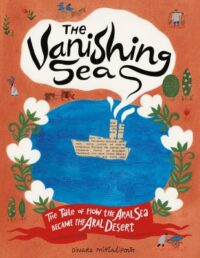
The vanishing sea : the tale of how the Aral Sea became the Aral Desert written and illustrated by Dinara Mirtalipova.
This artful and thought-provoking picture book shares the little-known story of the disappearance of the Aral Sea—and the loss of livelihood and biodiversity as fishing villages and ships were left stranded in the desert without water.
The Aral Sea once stretched across modern-day Uzbekistan and Kazakhstan. A large saltwater lake of Central Asia (called “sea” because of its vastness), the Aral Sea’s 26 square miles (67 square kilometers) sustained its surrounding communities for generations. Beginning in the 1960s, aggressive Soviet industrialization diverted water for agricultural production and caused the lake to shrink.
Today, the waters that had thrived for centuries have almost entirely disappeared—and along with them, the biodiversity of the lake, its thriving fishing industry, and the many homes along its shores.
Told in a folkloric style with stunning illustrations, this true tale chronicles what happens when nature’s generosity is exploited. It gently invites readers to consider the reality of irreversible environmental harm, its global impact, and what it means to be compassionate to the land we live on. – Chronicle Books
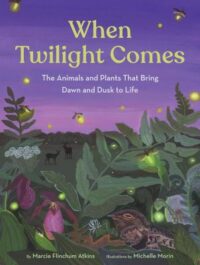
When twilight comes : the animals and plants that bring dawn and dusk to life by Marcie Flinchum Atkins ; illustrated by Michelle Morin.
Turn the pages of this luminous picture book to take a walk through the special moments between day and night, and discover a world full of secrets and surprises that unfold only in the twilight.
When twilight comes, nature transitions: from night to day at dawn and from day to night at dusk. Inside our homes, we are getting ready to start our days or end them, but outside, crepuscular creatures, animals that are most active at dawn or dusk, are right in the middle of their days!
This engaging nonfiction picture book shows familiar animals and beautiful flowers, skunks, white-tailed deer, fireflies, morning glories, evening primroses, and more in a whole new light, focusing on the behaviors, adaptations, and activities that define each as a crepuscular creature or plant. The lushly illustrated pages demonstrate the interconnected interactions between critters and their environments, powerfully showing how each is essential to the ecosystem as a whole.
From the first page welcoming the dawn to the last page beckoning us to venture outside during the magical in-between times, this mesmerizing book encourages young readers to compare and contrast the rhythms of the natural world with the rhythms of their own days, inviting curiosity and encouraging comfort with transition times. – Chronicle Books
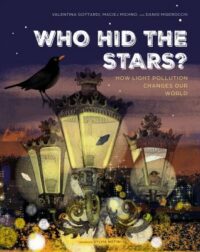
Who hid the stars? : how light pollution changes our world written by Valentina Gottardi, Maciej Michno, Danio Miserocchi ; illustrated by Valentina Gottardi ; translated by Sylvia Notini
A richly illustrated picture book exploring light pollution and its surprising impact on nature and wildlife.
When streetlights outshine the stars, what does that mean for plants, animals, and us? This absorbing nonfiction picture book investigates artificial light and its unexpected impact on our planet. Who Hid the Stars? explores fascinating topics including:
How artificial light developed throughout history—from fire to LEDs
How city lights interrupt bird migration patterns
How streetlights gather insects—and their predators
How turtles struggle to hatch without darkness
How plant growth changes in artificial light
How humans can fight light pollution and stop it from harming nature!
With lush ink, acrylic, and digital illustrations and scientifically sound, yet approachable text, Who Hid the Stars? is a memorable way to explore conservation and biodiversity. This book will ignite children’s curiosity and inspire them to take care of Earth—starting by turning out the lights.
Translated from Italian by Batchelder Award winner Sylvia Notini, Who Hid the Stars? includes a glossary of terms, a further reading list, and a link to the authors’ bibliography. The browsable book is ideal for STEAM units along with Earth Day and World Wildlife Day celebrations. – Eerdmans Books for Young Readers
Leave a Reply