
If you’re looking for a new science read, let us recommend you some new nonfiction books about climate change! As of this writing, all of these titles are owned by the Davenport Public Library. Descriptions are provided by the publishers.
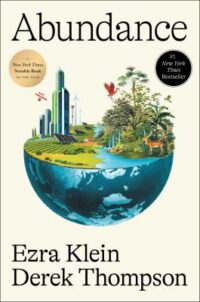
Abundance by Ezra Klein and Derek Thompson.
To trace the history of the twenty-first century so far is to trace a history of unaffordability and shortage. After years of refusing to build sufficient housing, America has a national housing crisis. After years of limiting immigration, we don’t have enough workers. Despite decades of being warned about the consequences of climate change, we haven’t built anything close to the clean-energy infrastructure we need. Ambitious public projects are finished late and over budget—if they are ever finished at all. The crisis that’s clicking into focus now has been building for decades—because we haven’t been building enough.
Abundance explains that our problems today are not the results of yesteryear’s villains. Rather, one generation’s solutions have become the next generation’s problems. Rules and regulations designed to solve the problems of the 1970s often prevent urban-density and green-energy projects that would help solve the problems of the 2020s. Laws meant to ensure that government considers the consequences of its actions have made it too difficult for government to act consequentially. In the last few decades, our capacity to see problems has sharpened while our ability to solve them has diminished.
Progress requires facing up to the institutions in life that are not working as they need to. It means, for liberals, recognizing when the government is failing. It means, for conservatives, recognizing when the government is needed. In a book exploring how we can move from a liberalism that not only protects and preserves but also builds, Klein and Thompson trace the political, economic, and cultural barriers to progress and propose a path toward a politics of abundance. At a time when movements of scarcity are gaining power in country after country, this is an answer that meets the challenges of the moment while grappling honestly with the fury so many rightfully feel. – Avid Reader Press
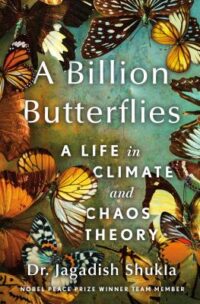
A billion butterflies : a life in climate and chaos theory by Dr. Jagadish Shukla
The amazing true story of the man behind modern weather prediction
Consider a world without weather prediction. How would we know when to evacuate communities ahead of fires or floods, or figure out what to wear tomorrow? Until 40 years ago, we couldn’t forecast weather conditions beyond ten days. Renowned climate scientist Dr. Jagadish Shukla is largely to thank for modern weather forecasting. Born in rural India with no electricity, plumbing, or formal schools, he attended classes that were held in a cow shed. Shukla grew up amid turmoil: overwhelming monsoons, devastating droughts, and unpredictable crop yields. His drive brought him to the Indian Institute of Tropical Meteorology, despite little experience. He then followed an unlikely path to MIT and Princeton, and the highest echelons of climate science. His work, which has enabled us to predict weather farther into the future than previously thought possible, allows us to feed more people, save lives, and hold on to hope in a warming world.
Paired with his philanthropic endeavors and extreme dedication to the field, Dr. Shukla has been lauded internationally for his achievements, including a shared Nobel Peace Prize with Al Gore for his governmental research on climate change. A Billion Butterflies is a wondrous insider’s account of climate science and an unbelievable memoir of his life. Understanding dynamical seasonal prediction will change the way you experience a thunderstorm or interpret a forecast; understanding its origins and the remarkable story of the man who discovered it will change the way you see our world. – St. Martin’s Press
Climate Change Science: A Primer for Sustainable Development by John C. Mutter
How will future climates be different from today’s world—and what consequences will changes in climate have for societies and their development strategies? This book is a primer on the essential science for grasping the workings of climate change and climate prediction. It is accessible for readers with little to no background in science, with an emphasis on the needs of those studying sustainable development.
John C. Mutter gives a just-the-facts overview of how the climate system functions and what we know about why changes occur. He recounts the evolution of climatology from the earliest discoveries about Earth’s climate to present-day predictive capabilities, and clearly presents the scientific basis of fundamental topics such as climate zones, ocean-atmosphere dynamics, and the long-term cycles from glacial to interglacial periods. Mutter also details the mechanisms of climate change and the ways in which human activity affects global climate. He explains the science behind some known consequences of rising temperatures, such as sea level rise, hurricane behavior, and climate variability. The primer discusses how climate predictions are made and examines the sources of uncertainty in forecasting. Climate Change Science is a straightforward and easy-to-read treatment of the fundamental science needed to comprehend one of today’s most important issues. – Columbia University Press
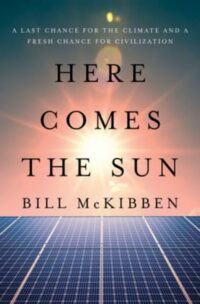
Here comes the sun : a last chance for the climate and a fresh chance for civilization by Bill McKibben
From the acclaimed environmentalist, a call to harness the power of the sun and rewrite our scientific, economic, and political future.
Our climate, and our democracy, are melting down. But Bill McKibben, one of the first to sound the alarm about the climate crisis, insists the moment is also full of possibility. Energy from the sun and wind is suddenly the cheapest power on the planet and growing faster than any energy source in history—if we can keep accelerating the pace, we have a chance.
Here Comes the Sun tells the story of the sudden spike in power from the sun and wind—and the desperate fight of the fossil fuel industry and their politicians to hold this new power at bay. From the everyday citizens who installed solar panels equal to a third of Pakistan’s electric grid in a year to the world’s sixth-largest economy—California—nearly halving its use of natural gas in the last two years, Bill McKibben traces the arrival of plentiful, inexpensive solar energy. And he shows how solar power is more than just a path out of the climate crisis: it is a chance to reorder the world on saner and more humane grounds. You can’t hoard solar energy or hold it in reserves—it’s available to all.
There’s no guarantee we can make this change in time, but there is a hope—in McKibben’s eyes, our best hope for a new civilization: one that looks up to the sun, every day, as the star that fuels our world. – W.W. Norton & Co.
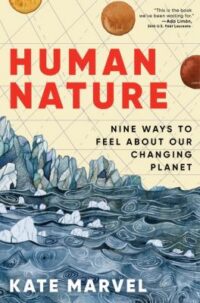
Human nature : nine ways to feel about our changing planet by Kate Marvel
A captivating exploration of climate change that uses nine different emotions to better understand the science, history, and future of our evolving planet
Scientist Kate Marvel has seen the world end before, sometimes several times a day. In the computer models she uses to study climate change, it’s easy to simulate rising temperatures, catastrophic outcomes, and bleak futures. But climate change isn’t just happening in those models. It’s happening here, to the only good planet in the universe. It’s happening to us. And she has feelings about that.
Human Nature is a deeply felt inquiry into our rapidly changing Earth. In each chapter, Marvel uses a different emotion to explore the science and stories behind climate change. As expected, there is anger, fear, and grief—but also wonder, hope, and love. With her singular voice, Marvel takes us on a soaring journey, one filled with mythology, physics, witchcraft, bad movies, volcanoes, Roman emperors, sequoia groves, and the many small miracles of nature we usually take for granted.
Hopeful, heartbreaking, and surprisingly funny, Human Nature is a vital, wondrous exploration of how it feels to live in a changing world. – Ecco
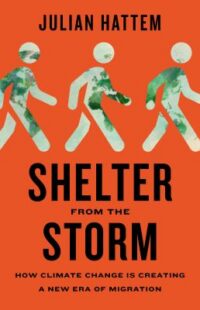
Shelter from the storm : how climate change is creating a new era of migration by Julian Hattem
An urgent wake-up call about the coming large-scale human displacement caused by climate change, from one of the world’s leading experts
Mere decades from now, millions of people all over the world will be forced to move because of climate change. Entire islands will disappear into the sea. Once-in-a-century hurricanes will occur on a regular basis, decimating cities and wiping out peoples’ homes. Wildfires fed by prolonged drought will rage through communities. No one will be immune: in countries rich and poor, climate change will usher in a new era of migration.
In Shelter from the Storm noted journalist and migration researcher Julian Hattem tells the story of the massive human displacement that is already being caused by climate change. With hard-hitting journalism from the front lines of the environmental apocalypse, Hattem takes the reader on a journey from the South Pacific to the Indian subcontinent, the Mediterranean, and beyond, offering a shocking glimpse into the human geography wrecked by a warming planet.
Shelter from the Storm also provides rich historical perspective on how climate has impacted migration and a primer on cutting-edge climatological research, creating a multidimensional portrait of this uncertain new age. A work of profound expertise and storytelling, Shelter from the Storm gives a human face to the millions of climate migrants who are leaving their homes—and the millions more who will follow. – The New Press

Surviving climate anxiety : a guide to coping, healing, and thriving by Dr. Thomas Doherty
With climate disasters mounting and solutions feeling ever more elusive, eco-anxiety is rapidly becoming one of the biggest mental health threats of our time.
Surviving Climate Anxiety is the essential guide to coping with the psychological impacts of persistent environmental crisis. In it, the world’s leading climate anxiety expert Dr. Thomas Doherty shares his pioneering, evidence-based methods to help you:
- Reclaim your nervous system: manage your thoughts and feelings, and stress about climate change
- Understand your environmental identity: your history, values, and connection to the natural world
- Prioritize eco-wellness: Utilize arts, creativity, and spirituality as tools for flourishing
- Liberate yourself from living as a climate hostage: overcome fear of climate disasters and tend to eco-depression and grief
- Broaden your horizons of hope: cultivate optimism through stewardship and action
Packed with practical, research-backed tips and dozens of stories – from the geologist haunted by images of melting glaciers, to the young couple agonizing over whether to bring a child into a world on fire, to a twenty-something wondering what it was like back when people believed in a future – Surviving Climate Anxiety provides the tools to cope, heal, and flourish, even in these times. – Little Brown Spark
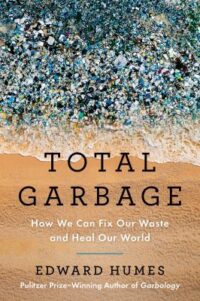
Total garbage : how we can fix our waste and heal our world by Edward Humes
An investigative narrative that dives into the waste embedded in our daily lives—and shows how individuals and communities are making a real difference for health, prosperity, quality of life and the fight against climate change, by a Pulitzer Prize winning journalist
What happens to our trash? Why are our oceans filling with plastic? Do we really waste 40 percent of our food 65 percent of our energy? Waste is truly our biggest problem, and solving our inherent trashiness can fix our economy, our energy costs, our traffic jams, and help slow climate change—all while making us healthier, happier and more prosperous. This story-driven and in-depth exploration of the pervasive yet hard-to-see wastefulness that permeates our daily lives illuminates the ways in which we’ve been duped into accepting absolutely insane levels of waste as normal. Total Garbage also tells the story of individuals and communities who are finding the way back from waste, and showing us that our choices truly matter and make a difference.
Our big environmental challenges – climate, energy, plastic pollution, deforestation, toxic emissions—are often framed as problems too big for any one person to solve. Too big even for hope. But when viewed as symptoms of a single greater problem—the epic levels of trash and waste we produce daily–the way forward is clear. Waste is the one problem individuals can positively impact—and not just on the planet, but also on our wallets, our health, and national and energy security. The challenge is seeing our epic wastefulness clearly.
Total Garbage will shine a light on the absurdity of the systems that all of us use daily and take for granted–and it will help both individuals and communities make meaningful changes toward better lives and a cleaner, greener world. – Avery
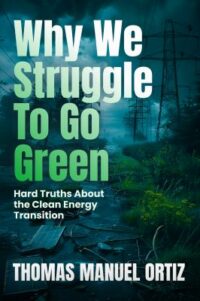
Why we struggle to go green: hard truths about the clean energy transition by Thomas Manuel Ortiz
Clean energy won’t save us from the effects of climate change.
Amid corporate Net Zero campaigns, the politics of the Green New Deal, and the calls to abandon fossil fuels for renewable technology — or vice versa — lies a troubling truth: No clean technological solutions can solve the problem of human-induced climate change.
To find a credible path to a sustainable future, we must set aside hopes of building our way out of humanity’s addictions to energy and material convenience. In Why We Struggle to Go Green, Tom Ortiz offers a clear-eyed assessment of our efforts to mitigate the effects of climate change. As a mechanical engineer who has traversed the conventional and renewable energy landscapes for 30 years, Ortiz provides an in-depth yet easy-to-understand assessment of the harsh reality facing mankind.
Bridging the gap between academic research and journalism, Ortiz shows why there are no easy answers in the energy transition. Beginning with a general overview of human energy use and a summary of key physical constraints on energy and natural resource extraction, the book details five pillars of the transition: electrification, carbon capture and storage, hydrogen, recycling, and carbon pricing. Ortiz concludes with recommendations for changes society can make that, while perhaps painful and controversial, will reduce our collective environmental impact and bequeath a more manageable legacy to future generations.
Why We Struggle to Go Green cuts through the hype and rhetoric to offer something rare: climate change realism from someone who’s spent decades looking for solutions. – Stoney Creek Publishing Group
Leave a Reply