
Hispanic Heritage Month runs September 15th through October 15th. The theme for 2026 is “UNIDOS, SOMOS MÁS.” “TOGETHER, WE ARE MORE.” This theme celebrates family, resilience, creativity, faith, and service by honoring the diverse stories that strengthen our nation, investing in the future, and building a stronger America for all. To help celebrate the theme, we have gathered a list of nonfiction titles to read for Hispanic Heritage Month.
As of this writing, all of these titles are owned by the Davenport Public Library. Descriptions are provided by the publishers.
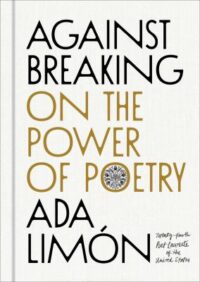
Against breaking : on the power of poetry by Ada Limón
24th Poet Laureate of the United States Ada Limón inspires us to see poetry as much more than just words—as a powerful force for healing, a call to action, and a vibrant celebration of humanity’s many voices.
Ada Limón—celebrated poet laureate and 2023 MacArthur fellow—takes us on an inspiring journey into a world where poetry is both a soothing balm for the soul and a spark for transformation. With her blend of accessible yet profound prose, Limón delivers a powerful message: poetry has the ability to heal, connect, and remind us of our shared humanity.
Limón’s mission to make poetry approachable shines brightly in this slim but impactful book. Recognized as a 2024 Time magazine Woman of the Year for her commitment to bringing poetry into everyday lives, Limón passionately argues that poetry is essential to understanding ourselves—our tenderness, courage, imperfections, and our deep, unshakable worthiness of love.
Drawing from her own experiences as the 24th US poet laureate, Limón shares how poetry connects us not only to each other but to the natural world. This theme is at the heart of her project You Are Here, which celebrates the beauty of our environment and our place in it. Her prose, like her poetry, feels like an open invitation—welcoming readers of all backgrounds to explore the richness of human experience through verse.
Fans of Robin Wall Kimmerer, Matthew Zapruder, or Jesmyn Ward will find a kindred spirit in Against Breaking—which offers a refuge, a reminder of the resilience and beauty found within us and all around us. As Limón writes with heartfelt clarity, “If you need to remember what makes us human, tender, brave, flawed, and worthy of love, you need poetry.” – Scribner
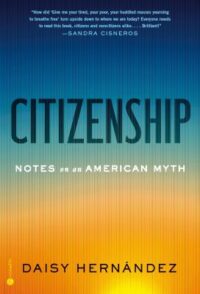
Citizenship : notes on an American myth by Daisy Hernández
In this one-of-a-kind book, Daisy Hernández fiercely interrogates one of the most complicated subjects of contemporary life and politics: citizenship. Braiding memoir, history, and cultural criticism, she exposes the truths and lies of how we define ourselves as a country and a people. Turning to her own family’s stories—her mother arrived from Colombia, while her father was a political refugee from Castro’s Cuba—Hernández shows how the very idea of citizenship is a myth, one of the stories we tell ourselves about the American soul and psyche.
Reframing our understanding of what it means to be an American, Citizenship is an urgent and necessary account of the laws, customs, and language we use to include and exclude, especially those who come from Latin America. With her scholar’s mind and memoirist’s gift for narrative, Hernández weaves a story both personal and national, while reckoning with our country’s ongoing debate about who belongs and providing fresh ways of thinking about citizenship. At once bracing, fearless, and tender, Citizenship is a powerful portrait of one family’s experiences in the borderlands of citizenship and an honest illumination of the country in which we live. – Hogarth
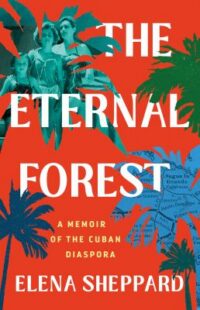
The eternal forest : a memoir of the Cuban diaspora by Elena Sheppard
A memoir of the Cuban diaspora that follows one family’s exile from the island, through a lyrical exploration of memory, cultural mythology, and the history of Cuban-American relations.
History is undeniably dominated by its men, but the stories Elena Sheppard was brought up on were almost always about Cuba’s women—everyday women, whose names would be forgotten and buried along with their bones unless someone took the effort to remember them.
Cifuentes, Cuba, in the 1950s was nearly idyllic—at least that’s how Elena’s grandparents, Rosita and Gustavo Delgado, remember the Eden they left. When Fidel Castro seized power in 1959, Gustavo was placed on a list of political undesirables, and by the end of 1960, the couple and their two daughters had fled to Florida, with nothing more than five dollars, and a suitcase each. The Delgados were certain they would return to Cifuentes within a few months, after Castro’s reign had run its course. But they never went back, and a piece of each of their identities became frozen in that moment.
In 1987, Elena was the first in Gustavo and Rosita’s family to be born in the United States, but through the memories that lived on in her grandmother’s mind, Cuba became the foundation of her childhood. Elena takes us inside these stories, and as we travel back and forth across the narrow Florida Straits that separate Miami and Havana, we also weave between past and present, to discover family secrets that are on the brink of being lost to time.
In lyrical yet unflinching prose, The Eternal Forest follows one family’s exile from their homeland and in so doing, it tells the larger political story of the Cuban Revolution and its diaspora. Through a spellbinding blend of cultural myth, historical texts, and personal narrative, The Eternal Forest seeks to understand the nature of inheritance, how trauma and memory are passed down through generations, and what it means to yearn for an island you can never fully know. – St. Martin’s Press
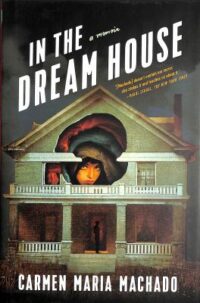
In the dream house : a memoir by Carmen Maria Machado
In the Dream House is Carmen Maria Machado’s engrossing and wildly innovative account of a relationship gone bad, and a bold dissection of the mechanisms and cultural representations of psychological abuse. Tracing the full arc of a harrowing relationship with a charismatic but volatile woman, Machado struggles to make sense of how what happened to her shaped the person she was becoming.
And it’s that struggle that gives the book its original structure: each chapter is driven by its own narrative trope—the haunted house, erotica, the bildungsroman—through which Machado holds the events up to the light and examines them from different angles. She looks back at her religious adolescence, unpacks the stereotype of lesbian relationships as safe and utopian, and widens the view with essayistic explorations of the history and reality of abuse in queer relationships.
Machado’s dire narrative is leavened with her characteristic wit, playfulness, and openness to inquiry. She casts a critical eye over legal proceedings, fairy tales, Star Trek, and Disney villains, as well as iconic works of film and fiction. The result is a wrenching, riveting book that explodes our ideas about what a memoir can do and be. – Graywolf Press
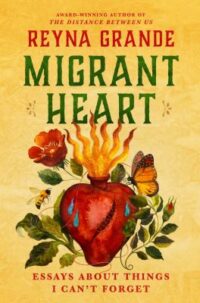
Migrant heart: Essays about Things I can’t Forget by Reyna Grande
An ambitious memoir in essays by beloved bestselling author Reyna Grande that illuminates the hidden cost of the American Dream and the complex journey of healing that follows survival.
What is the true power of stories? Can they heal the jagged edges of a traumatic childhood? Is the cost of telling the story worth the price of the cure?
Reyna Grande has spent her career capturing the raw reality of life across borders. In this intricate and deeply intimate memoir-in-essays, the author of the landmark memoirs The Distance Between Us and A Dream Called Home again turns her gaze inward to explore the scars left by migration and the ongoing work of stitching herself back together.
With her signature blend of sophistication and raw honesty, Grande interrogates how living between two nations, two languages, and two identities has shaped the woman, mother, and writer she has become. Moving from the legacy of violence in her hometown of Iguala, Mexico, to a bittersweet family vacation in Europe spent reconciling her own impoverished past with her children’s world of abundance, she uncovers startling truths about the nature of survival.
Whether being racially profiled in the Arizona borderlands or finding unexpected wisdom from the slugs in her garden, Grande unflinchingly asks: How do we bridge the gap between who we were and who we have become? How do we turn pain into power? When memory threatens to define us, how can we use story to heal while still honoring our boundaries?
Migrant Heart is a powerful testament to Grande’s role as a storyteller and cultural witness. It expands our understanding of life in the United States and the complex people who cross and live within its borders. It is an essential read for the seekers, the dreamers, and anyone who believes in the enduring, transformative power of finding one’s voice. – Atria/Primero Sueno Press
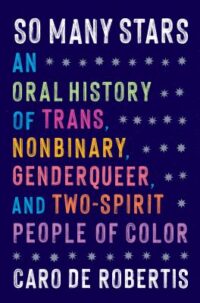
So many stars : an oral history of trans, nonbinary, genderqueer, and two-spirit people of color by Caro De Robertis
From an acclaimed novelist, a first-of-its-kind, deeply personal, and moving oral history of a generation of trans and gender nonconforming elders of color—from leading activists to artists to ordinary citizens—who tell their own stories of breathtaking courage, cultural innovations, and acts of resistance.
So Many Stars knits together the voices of trans, nonbinary, genderqueer, and two-spirit elders of color as they share authentic, intimate accounts of how they created space for themselves and their communities in the world. This singular project collects the testimonies of twenty elders, each a glimmering thread in a luminous tapestry, preserving their words for future generations—who can more fully exist in the world today because of these very trailblazers.
De Robertis creates a collective coming-of-age story based on hundreds of hours of interviews, offering rare snapshots of ordinary life: kids growing up, navigating family issues and finding community, coming out and changing how they identify over the years, building movements and weathering the AIDS crisis, and sharing wisdom for future generations. Often narrating experiences that took place before they had the array of language that exists today to self-identify beyond the gender binary, this generation lived through remarkable changes in American culture, shaped American culture, and yet rarely takes center stage in the history books. Their stories feel particularly urgent in the current political moment, but also remind readers that their experiences are not new, and that young trans and nonbinary people today belong to a long lineage.
The anecdotes in these pages are riveting, joyful, heartbreaking, full of personality and wisdom, and artfully woven together into one immersive narrative. In De Robertis’s words, So Many Stars shares “behind-the-scenes tales of what it meant—and still means—to create an authentic life, against the odds.” – Algonquin Books
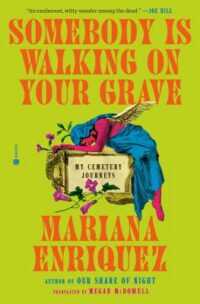
Somebody is walking on your grave by Mariana Enriquez ; translated by Megan McDowell
Cemeteries have great stories and sometimes I steal some for my books.
Mariana Enriquez—called by The New York Times a “sorceress of horror”—has been fascinated by the haunting beauty of cemeteries since she was a teenager. She has visited them frequently, a goth flaneur taking notes on her aesthetic obsession as she walks among the headstones, “where dying seems much more interesting than being alive.”
But when the body of a friend’s mother who was disappeared during Argentina’s military dictatorship was found in a common grave, Enriquez began to examine more deeply the complex meanings of cemeteries and where our bodies come to rest.
In this rich book of essays—“excursions through death,” she calls them—Enriquez travels through North and South America, Europe and Australia, visiting Paris’s catacombs, Prague’s Old Jewish Cemetery, New Orleans’s aboveground mausoleums, Buenos Aires’s opulent Recoleta, and more. Enriquez investigates each cemetery’s history and architecture, its saints and ghosts, its caretakers and visitors, and, of course, its dead.
Weaving personal stories with reportage, interviews, myths, hauntology, and more, Somebody Is Walking on Your Grave is memoir channeled through Enriquez’s passion for cemeteries, revealing as much about her own life and unique sensibility as the graveyards and tombstones she tours. Fascinating, spooky, and unlike anything else, Enriquez’s first work of nonfiction, translated by the award-winning Megan McDowell, is as original and memorable as the stories and novels for which she’s become so beloved and admired. – Hogarth
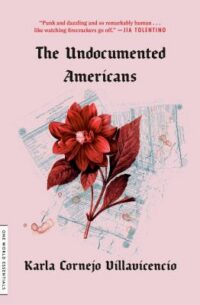
The Undocumented Americans by Karla Cornejo Villavicencio
Writer Karla Cornejo Villavicencio was on DACA when she decided to write about being undocumented for the first time using her own name. It was right after the election of 2016, the day she realized the story she’d tried to steer clear of was the only one she wanted to tell. So she wrote her immigration lawyer’s phone number on her hand in Sharpie and embarked on a trip across the country to tell the stories of her fellow undocumented immigrants—and to find the hidden key to her own.
Looking beyond the flashpoints of the border or the activism of the DREAMers, Cornejo Villavicencio explores the lives of the undocumented—and the mysteries of her own life. She finds the singular, effervescent characters across the nation often reduced in the media to political pawns or nameless laborers. The stories she tells are not deferential or naively inspirational but show the love, magic, heartbreak, insanity, and vulgarity that infuse the day-to-day lives of her subjects.
In New York, we meet the undocumented workers who were recruited into the federally funded Ground Zero cleanup after 9/11. In Miami, we enter the ubiquitous botanicas, which offer medicinal herbs and potions to those whose status blocks them from any other healthcare options. In Flint, Michigan, we learn of demands for state ID in order to receive life-saving clean water. In Connecticut, Cornejo Villavicencio, childless by choice, finds family in two teenage girls whose father is in sanctuary. And through it all we see the author grappling with the biggest questions of love, duty, family, and survival.
In her incandescent, relentlessly probing voice, Karla Cornejo Villavicencio combines sensitive reporting and powerful personal narratives to bring to light remarkable stories of resilience, madness, and death. Through these stories we come to understand what it truly means to be a stray. An expendable. A hero. An American. – One World