
John Looney Gang operated in the Quad Cities in the 1920s. Rumors abound that Chicago mob figures also used underground tunnels, safehouses, and remote river roads in the Quad Cities during the 1920s and 1930s to move bootleg whiskey and to lay low. The historic underground scene in the Quad Cities is fascinating, but for those wanting to read about gangs, cartels, and the mafia outside this area, we have written up a list of nonfiction titles below for you to check out.
As of this writing, all of these titles are owned by the Davenport Public Library. Descriptions are provided by the publishers.
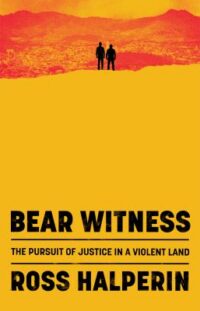
Bear witness : the pursuit of justice in a violent land by Ross Halperin
A high-octane true-crime story, Bear Witness follows two Christians who refuse to let fear or conventional wisdom stand in the way of their altruistic mission.
The vast majority of Hondurans would have never dared to set foot in Nueva Suyapa, a mountainside barrio that was under the thumb of a gang whose bravado and cruelty were the stuff of legend. But that is precisely where Kurt Ver Beek, an American sociologist, and Carlos Hernández, a Honduran schoolteacher, chose to raise their families. Kurt and Carlos were best friends who had committed their lives to helping the poor, and when they accepted that nobody else—not the police, not the prosecutors, not the NGOs—was ever going to protect their neighbors from the incessant violence they suffered, they decided to take matters into their own hands.
In magnetic prose, journalist Ross Halperin chronicles how these two do-gooders became quasi-vigilantes and charged into a series of life-and-death battles, not just with this one gang, but also with forces far more dangerous, including a notorious tycoon who commanded about a thousand armed men and a police force whose wickedness defied credulity. Kurt and Carlos would eventually get catapulted from obscurity to being famous power players who had access to the backrooms where legislators, ambassadors, and presidents pulled strings. Their efforts made some of the most violent neighborhoods on earth safer and arguably improved a profoundly corrupt government. But they were forced to compromise their principles in order to make all that happen, and furthermore, they acquired a large number of outraged critics and precipitated some heartbreaking collateral damage.
A remarkable and dangerous feat of reportage, Bear Witness shows what happens when altruism, faith, and an obsession with justice are pushed to the extreme. – Liveright
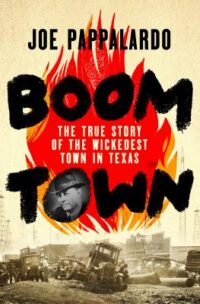
Boomtown : the true story of the wickedest town in Texas by Joe Pappalardo
The true story of the corrupt and violent town of Borger, Texas in 1927―and the legendary Texas Ranger tasked with taming it.
Just a year after the town of Borger, Texas was founded, the press already called it “the wickedest in the state.” The town, sprung into existence overnight to support new oilfields, was a lawless haven for bootleggers, pimps and gamblers, run by a crooked city hall and corrupt police. The town also became a haven for those seeking second chances, including dance hall operators, storeowners, wrestlers, lawyers and freelance oil well firefighters.
But the raucous environment attracted some of the most unsavory characters in prohibition America, including a gang of murderous bank robbers who head into Borger to spend their money on booze, gambling and prostitutes. In the span of weeks, the robbers killed three law enforcement officers, bringing the worst heat imaginable: iconic Texas Ranger Captain Frank Hamer, just a few years before his takedown of Bonnie and Clyde. His arrival threatens to break the hardest boomtown in America―if it doesn’t kill him first. – St. Martin’s Press
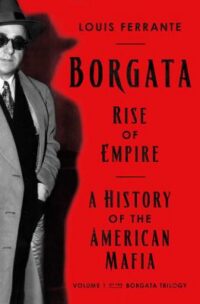
Borgata : rise of empire : a history of the American Mafia by Louis Ferrante
A riveting history of the Mafia from 1860s Sicily to 1960s America—as narrated by a former heist expert and Gambino family mobster.
The culmination Louis Ferrante’s exhaustive research delving deep into Sicily’s socio-economic-political roots, Borgata: Rise of Empire will finally reveal exactly how and why this infamous secret society formed inside Sicilian culture. Ferrante then engages in the art of storytelling by carefully selecting stories about the mafia in Sicily that allow him to follow the main characters to America, where most arrive as fugitives from Italian justice.
Across the Atlantic, the storyline picks up in places like New York and New Orleans, where the clannish Sicilians quickly realize the importance of diversity as they forge new alliances with other recently arrived ethnic groups as the borgata becomes the premier organized criminal network in the country. After planting their flags in cities across America, the adolescent American mafia realizes how to corrupt America’s police and political establishment, and they become experts at bribing public officials, allowing them to extend their tentacles into every level of American society.
In this first volume, Ferrante traces the mafia’s phenomenal “rise of empire” through larger-than-life characters such as Lucky Luciano, Vito Genovese, Meyer Lansky, Bugsy Seigel, Albert Anastasia, and other legendary mobsters as they provide alcohol to the American public during Prohibition, penetrate industrial labor unions, practically take over the island of Cuba and, with extraordinary vision, create the gambling mecca of Las Vegas. – Pegasus Books
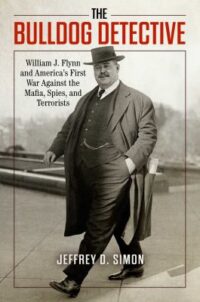
The bulldog detective : William J. Flynn and America’s first war against the mafia, spies, and terrorists by Jeffrey D. Simon
America in the early twentieth century was rife with threats. Organized crime groups like the Mafia, German spies embedded behind enemy lines ahead of World War I, package bombs sent throughout the country, and the 1920 Wall Street bombing dominated headlines. Yet the story of the one man tasked with combating these threats has yet to be told. The Bulldog Detective: William J. Flynn and America’s First War Against the Mafia, Spies, and Terrorists is the first book to tell the story of Flynn, the first government official to bring down the powerful Mafia, uncover a sophisticated German spy ring in the United States, and launch a formal war on terrorism on his way to becoming one of the most respected and effective law enforcement officials in American history.
Long before Eliot Ness and the Untouchables went after Al Capone and the Italian mob in Chicago, Flynn dismantled the first Mafia family to exist in America. Next stop for the indefatigable crime fighter would be Chief of the Secret Service where he would set his crosshairs on the country’s most notorious currency counterfeiters. Coined “the Bulldog” for his tenacity, Flynn’s fame soared as he exposed Kaiser Germany’s sophisticated spy and sabotage ring on the cusp of America’s entry into World War I. As the Director of the Bureau of Investigation (the forerunner of the FBI), the Bulldog would devise the first counterterrorist strategy in U.S. history. In this riveting biography, author Jeffrey D. Simon brings to life the forgotten saga of one of America’s greatest crime and terrorist fighters. Exquisitely researched, The Bulldog Detective finally uncovers the important legacy of this fascinating man who will now no longer be lost in history. – Prometheus
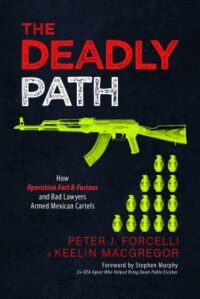
The deadly path : how Operation Fast & Furious and bad lawyers armed Mexican cartels by Peter J. Forcelli & Keelin MacGregor
Pete Forcelli did what members of the U.S. Congress encourage government employees to do: he spoke up when he saw misconduct within the federal government. But choosing to be a whistleblower almost cost Forcelli his job, his possessions, and his reputation as a law enforcement official.
“In a raw and unflinching account that details his harrowing journey as whistleblower in the Fast and Furious federal scandal, Forcelli shows the public and personal cost of standing up for justice.” —Jonathan Green, author of Sex Money Murder: A Story of Crack, Blood, and Betrayal
Pete Forcelli was a highly respected federal agent in New York City, where he made an impact on violent crime by successfully targeting some of the city’s most violent street gangs by using federal racketeering and continuing criminal enterprise statutes in conjunction with federal prosecutors. In early 2007, he was promoted to a supervisory position in Phoenix and quickly discovered that federal prosecutors were not charging criminals for violating federal firearms laws, even in instances where they knew guns were being trafficked to ultra-violent drug cartels and then used in crimes that were shocking to the conscience.
When those very same prosecutors spoke about possibly indicting John Dodson, a special agent who blew the whistle on Operation Fast and Furious, Forcelli stepped forward and contacted Congress. Forcelli became a whistleblower himself, detailing how federal prosecutors in Arizona not only failed to prosecute gun traffickers, but allowed a man who was making hundreds of hand grenades for the Sinaloa Cartel to continue his operations unabated for years. At that moment, those prosecutors and officials from the Department of Justice came after him, leading to a nearly four-year battle for Forcelli to clear his name.
This book provides his insider’s account of the scandal that stands as one of the worst stains on federal law enforcement. – Knox Press
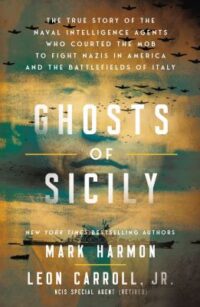
It’s 1942, and New York City is at war. German U-boats are sinking ships just miles offshore, and Washington, DC, is convinced that waterfront spies are providing intelligence targeting the ships. To thwart the threat, the Office of Naval Intelligence reaches out to those with the most sway along the waterfronts of Brooklyn and Manhattan – the mob. The result will be a triumph for the ONI and one of the most successful and controversial operations in the long history of what we now know as NCIS.
The Navy’s alliance with Charles “Lucky” Luciano and his organization will send New Yorker Tony Marsloe and his fellow ONI officers on an international odyssey that includes holding secret meetings with legendary criminals, hunting clandestine spy rings operating on U.S. soil, and conducting daring undercover missions behind the bloody frontlines of the invasion of Italy.
In addition to towering historic figures like Meyer Lansky and General George Patton, readers will encounter a kaleidoscope of agents and gangsters who not only shaped the war in Italy but the future of international crime itself. – Harper Select
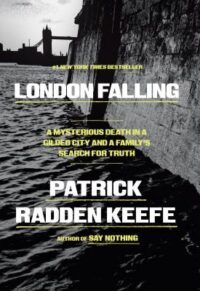
London falling : a mysterious death in a gilded city and a family’s search for truth by Patrick Radden Keefe
In the early morning of November 29th, 2019, surveillance cameras at the headquarters of MI6, Britain’s spy agency, captured video of a young man pacing back and forth on a high balcony of Riverwalk, a luxury tower on the bank of the river Thames. At 2:24 a.m., he jumped into the river.
In a quiet London neighborhood several miles away, Rachelle Brettler was worried about her son. Zac had told her that he had gone to stay with a friend for the weekend, but then he did not come home. Days later, a police car pulled up and two officers relayed the dreadful news: Her son was dead.
In their unbearable grief, Rachelle and her husband, Matthew, struggled to understand what had happened to Zac. He had had his troubles, but in no way seemed suicidal. As they would soon discover, however, there was a lot they did not know about their son. Only after his death did they learn that he had adopted a fictitious alter ego: Zac Ismailov, son of a Russian oligarch and heir to a great fortune. Under this guise, Zac had become entangled with a slippery London businessman named Akbar Shamji and a murderous gangster known as Indian Dave. As the Brettlers set about investigating their son’s death, they were pulled into a different and more dangerous London than the one they’d always known, and came to believe that something much more nefarious than a suicide had claimed Zac’s life. But to their immense frustration, Scotland Yard seemed unable—or unwilling—to bring the perpetrators to justice.
In a bravura feat of reporting and writing, Patrick Radden Keefe chronicles the Brettlers’ quest, peeling back layers of mystery and exposing the seedy truths behind the glamorous London of posh mansions and private nightclubs, a city in which everything is for sale, and aspirational fantasies are underwritten by dirty money and corruption. London Falling is a mesmerizing investigation of an inexplicable death and a powerful narrative driven by suspense and staggering revelations. But it is also an intimate and deeply poignant inquiry into the nature of parental love and the challenges of being a parent today, a portrait of a family trying to solve the riddle not just of how their son died, but of who he really was in life. – Doubleday
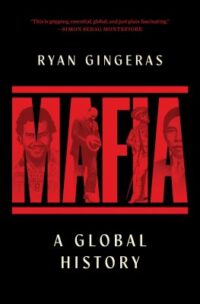
Mafia : a global history by Ryan Gingeras
A gripping and deeply researched exploration of the hidden influence of organized crime on the global economy that reveals the mafia as an uncredited architect of modern society.
In Mafia: A Global History, Ryan Gingeras takes readers on a fascinating journey into the shadowy world of organized crime and its far-reaching impact on contemporary society. From backroom deals to global power plays, this compelling narrative spans two centuries, unraveling the complex ties between crime syndicates and law enforcement—and how these relationships have reshaped both sides in unexpected ways.
Drawing on over a decade of in-depth research into the global drug trade, Gingeras profiles legendary figures like Al Capone, Pablo Escobar, El Chapo, and Dawood Ibrahim, bringing their stories to life while exposing how these mafias have tested the boundaries of state power. By challenging the law, these criminal networks force governments to adapt, leaving an indelible mark on governance, society, and the global economy.
Gingeras identifies three key spheres of transformation: the legal limits tested by mafias, their economic activities reflecting the Western bloc’s dominance in global trade, and their undeniable presence in pop culture. As crime syndicates continue to evolve in the 21st century, Gingeras highlights the alarming blurring of lines between gangsters, corporations, and political leaders—a trend that threatens to destabilize the global order.
For true crime fans and history buffs alike, Mafia is a must-read. With echoes of Mark Bowden’s Killing Pablo and Sam Quinones’s Dreamland, Gingeras delivers a masterful blend of storytelling and meticulous analysis that will leave you questioning just how much of the world around us is shaped by those operating in the shadows. – Avid Reader Press / Simon & Schuster
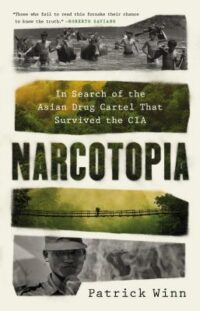
Narcotopia : in search of the Asian drug cartel that survived the CIA by Patrick Winn
The gripping true story of an indigenous people running the world’s mightiest narco-state—and America’s struggle to thwart them.
In Asia’s narcotics-producing heartland, the Wa reign supreme. They dominate the Golden Triangle, a mountainous stretch of Burma between Thailand and China. Their 30,000-strong army, wielding missiles and attack drones, makes Mexican cartels look like street gangs.
Wa moguls are unrivaled in the region’s $60 billion meth trade and infamous for mass-producing pink, vanilla-scented speed pills. Drugs finance Wa State, a bona fide nation with its own laws, anthems, schools, and electricity grid. Though revered by their people, Wa leaders are scorned by US policymakers as vicious “kingpins” who “poison our society for profit.”
In Narcotopia, award-winning journalist Patrick Winn uncovers the truth behind Asia’s top drug-trafficking organization, as told by a Wa commander turned DEA informant. This gripping narrative shreds drug war myths and leads to a chilling revelation: the Wa syndicate’s origins are smudged with CIA fingerprints.
This is a saga of native people tapping the power of narcotics to create a nation where there was none before — and covert US intelligence operations gone wrong. – PublicAffairs
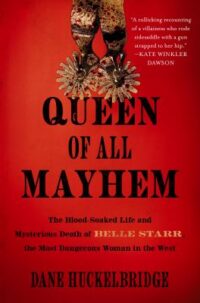
Queen of all mayhem : the blood-soaked life and mysterious death of Belle Starr, the most dangerous woman in the West by Dane Huckelbridge
A riveting, deeply researched, blood-on-the-spurs biography of Belle Starr, the most legendary female outlaw of the American West.
On February 3, 1889, just two days shy of her forty-first birthday, Myra Maybelle Shirley—better known at that point by her outlaw sobriquet “Belle Starr”—was blown from her horse saddle and killed by a pair of shotgun blasts, delivered by an unseen assailant, only a few miles away from her home in the Indian Territory of present-day Oklahoma. Thus ended the life of one of the most colorful, authentic, and dangerous women in the history of the American West.
While today’s household names like Annie Oakley and Calamity Jane had dubious criminal bona fides, Belle’s were not in any doubt. This notorious gunslinger led a gang of horse thieves (a very serious crime in an era when horses were often the basis of one’s livelihood); was romantically involved with two of the West’s most legendary outlaws, Cole Younger and Jim Reed (her first husband); and participated in stickups and robberies across present-day Texas and Oklahoma. When Reed was murdered, Belle crossed into the Cherokee Nation in Indian Territory, where she assimilated into the Cherokee tribe, a matrilineal society, and soon married Sam Starr, a direct descendant of Nanye’hi, the greatest female warrior in Cherokee history.
Dane Huckelbridge, acclaimed author of No Beast So Fierce, probes a life rich in contradictions and intrigue. Why did a woman who had considerable advantages in life—a good family, a decent education, solid marriage prospects, a clear path to financial security—choose to pursue a life of crime? The life of Belle Starr, the Bandit Queen, is one of almost endless trauma: the horrors of the Civil War, which destroyed her hometown and killed her beloved brother, Bud; the untimely deaths of her first two husbands, both of them murdered; a stint in Detroit’s notorious women’s prison. Her career coincided with those of Susan B. Anthony and Elizabeth Cady Stanton, and yet Belle Starr was a very different sort of feminist icon. – William Morrow
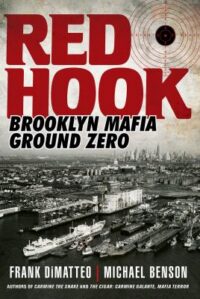
Red Hook : Brooklyn Mafia, ground zero by Frank DiMatteo and Michael Benson
Long before Brooklyn was known as the world’s hippest neighborhood, it was the deadliest – the seedy, dangerous underbelly of New York City, where mobsters and gangs could commit murder and dump dead bodies without getting caught.
For more than a hundred years, the Red Hook section of Brooklyn was Ground Zero for organized crime. Whoever controlled the piers controlled everything. From the infamous Irish gang known as The White Hand at the turn of the century, to the notorious Italian Gallo brothers who ran President Street—and everything else—generations later, the blood-soaked history of Red Hook is the story of American crime at its most powerful, corrupt, and coldly efficient.
It’s all here: the brutal Mob hits, bullet storms, and backstabbings of the most colorful cutthroats to ever terrorize the streets. A rogue’s gallery of killers with nicknames like “The Mad Hatter,” “The Executioner,” “Wild Bill,” and “Peg Leg.” The Brooklyn bar fight that gave Al “Scarface” Capone his legendary scars. The godfather of America’s first Sicilian crime family whose gruesomely mangled hand could scare men half to death. And, to bring it all home, the author’s own eyewitness account of multiple shootings growing up as the son of a Mafia bodyguard.
Packed with jaw-dropping stories of public violence and personal vengeance, vivid insights into the Mafia’s way of life, and shocking portraits of America’s most wanted crime families, Red Hook is a must-read for anyone fascinated by the history of organized crime in America. – Citadel
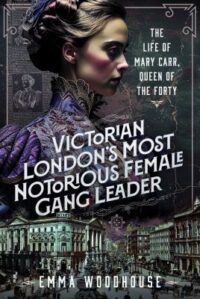
Victorian London’s most notorious female gang leader : the life of Mary Carr, Queen of the Forty by Emma Woodhouse
Born into the shadows of Victorian London, Mary Carr began her criminal career as a pickpocketing flower-girl, rising to be the undisputed Queen of the Forty Thieves. Under her rule, the Forty transformed from a band of violent, disorganised thieves into a ruthless, well-oiled gang, making a fortune from hotel robberies and blackmail. By 1891, Mary ruled Southwark, Lambeth, and beyond, her power extending from seedy back alleys to high society establishments.
But Mary was more than just a criminal mastermind. A ‘swan-necked beauty’ and muse to esteemed artist Frederic Leighton, she navigated both the art world and the criminal underworld with ease. She was a revered gang boss and a beloved benefactor, caring for the families of imprisoned comrades and ruling with both generosity and iron discipline.
When a young boy, Michael McGee, vanished at the Epsom races, eyes on the street turned to Mary, who had recently adopted a young blonde-haired boy and had been showing him off to the world. But her defiance would prove her undoing. Betrayed by an informant, she was arrested for child theft in 1896, sentenced to three years in prison, and lost everything. How does a woman who loses her home, her title and her son all in one blow rise again?
Emma Woodhouse’s compelling narrative unravels the legend of Mary Carr — a woman who defied Victorian expectations, reshaped London’s underworld, and became one of the most fascinating figures of her time. – Pen & Sword History
Leave a Reply